
Introduction
The „Justitia in Hungary” community was founded by several individuals who suffered police abuses, judicial corruption, became victims of bias, and were subjected to political pressure.
Hungary became a full member of the European Union on May 1, 2004. Before that, it was under communism for 40 years. Many hoped that joining the European Union would establish a rule of law in Hungary, and that people would no longer have to fear political pressure, persecution, or retribution. Unfortunately, this did not happen, and it seems that the situation has worsened in recent years.
It is a fact that it is a common occurrence in Hungary today for a politician, public figure, or judge to „place an order” with the police to humiliate someone. It is common practice to accuse someone of a crime without any reason or grounds, without having previously contacted, questioned, or interviewed them in connection with the case. The person receives a summons to the police, and upon arrival, they are humiliated through profiling and criminal registration. They are photographed, their fingerprints and palm prints are taken, a DNA sample is collected from them, and they are entered into the criminal registry. There have also been cases where someone was beaten and detained for a few days. After the procedure, they are acquitted and removed from the criminal registry. But sadly, by then, the individual has already suffered psychological damage. This is an accepted method of intimidation and the exercise of power in Hungary.
It also happens that the police carry out house searches „by order”. They rush to a location in a police car with sirens blaring, storm into a family’s home, and search the house for drugs. They find nothing, and it is later revealed that the search of the house was an abuse of power, ordered by a politician. The police aim to humiliate someone as much as possible.
Several people took their own life because of this, and recently there was a case where a police captain committed suicide because he did not want to carry out orders from „higher up.”
In reality, there is currently no oversight body for the police and the judiciary in Hungary, and there are no consequences for abuse of power. Even if someone submits a complaint to the police chief, the Minister of Interior, or the head of the prosecution and the court, in most cases, they do not even receive a response. Corrupt police officers and judges have nothing to fear; they can do anything, there are no limits, because there are no consequences for anything.
Hungary is not a state governed by the rule of law today.
Our Emblem
Today in Hungary, the Goddess Justitia does not have her eyes covered, but her mouth. And in her scales there are handcuffs, while the sword has been wrestled from her hand by a politician, a corrupt police officer, prosecutor, or judge.

Our Goal
Hungary is not a state governed by the rule of law today—in many cases, legislation serves political and economic interests. Where there is the rule of law, even a democratically elected government cannot do whatever it wants: judges, ombudsmen, civil society organizations, and journalists ensure that it cannot abuse its power. Where there is a rule of law, people can live in safety, without having to fear which politician might send the police after them. Our goal is to request a „lifeline” from European Union authorities and bodies.
- We demand that Hungarian politicians, police officers, mayors, high-ranking officials, and public servants be bound by the same rules as any ordinary citizen.
- We want the police in Hungary to be unable to arrest anyone on political orders. We want law enforcement and judicial authorities to operate independently, without any abuse of power. It should not happen that a politician, high ranking official or public figure gives the police an „order” to imprison, humiliate, or drag someone away.
- We demand that Act XC of 2017 on Criminal Procedure be amended so that no one can be declared „reasonably suspected” if the complainant is a public figure, politician, high-ranking official, public servant, etc. — without the police having even interrogated the suspect beforehand.
- We demand that the decision to order a criminal suspicion should not be made solely by the police, but should require authorization from two members of the prosecution office. We demand the same for search warrant procedures.
True story from Hungary
I.
Birthday gift: the first lawsuit of my life on my 50th birthday
In March 2026, I received a court summons from the court where the vice president of the county court works. The lawsuit was initiated because I had recorded the conversation with the mayor on video on August 7, 2025. The court hearing was on my 50th birthday, May 28, 2026—this is no coincidence, this was „ordered” by the mayor from the vice president of the county court. So, another „gift,” another form of political pressure, timed for my birthday. This fact clearly reflects why Hungary does not comply with the European Union’s rule of law conditions. In Hungary, a politician can arrange at a court for someone’s lawsuit to be scheduled on their birthday.
Unusually, despite this being a first-instance procedure, legal representation was mandatory. Unfortunately, I was unable to find a lawyer, even though I contacted almost every law firm in the given city. When they heard that it was a political case involving the vice president of the county court, no one dared to take on the case because they feared the vengeance and retaliation of the vice president of the county court. I contacted a legal defense foundation, which advised me to request a state-appointed „legal aid lawyer.” In Hungary, there is a law stating that if someone is eligible for such a service on social grounds or due to health impairments, the authority will appoint a lawyer in such cases. The authority designated an individual, who immediately declined because they feared retaliation from the vice president of the county court. Another lawyer was designated, and they also declined. A third lawyer was designated, and they declined as well—but the authority ultimately compelled them to provide representation for the lawsuit. Officially, I was assigned a lawyer on May 26, 2026, just two days before the court hearing on May 28, 2026. Therefore, for 92% of the duration of the lawsuit, I had no legal representation, which violates my constitutional rights. At the beginning of the case, I informed the judge that due to my severe health impairments and physical disability, I would be unable to attend the hearing in person, so I requested to participate online via remote hearing. I received a promise for this, yet the remote hearing was never implemented. I submitted petitions to the judge, but he disregarded those as well. In the correspondence, I clearly proved that the mayor was aware that my family home was equipped with cameras and that everything is recorded there. I attached photos for the judge showing the warning signs. This fact is also clearly evident from the privacy policy drafted for the security system, and the document explicitly states that these recordings—which were captured exclusively on my private property—may be published on the internet. I also informed the judge that the mayor qualifies as a public figure, and I am a registered journalist holding a press card. I sent him the position statement of the National Association of Hungarian Journalists, titled „Hands off investigative journalists. The judge disregarded these as well and made no mention of them in the court order. I object to the fact that the county court failed to take into account freedom of expression, freedom of the press, the free discussion of public affairs, democracy, etc. The judge ignored the documents I had submitted. On June 11, 2026, the county court rendered a judgment against me without the judge even hearing me out or considering the documents I had submitted. I was convicted on political grounds; my right to a fair trial was violated, along with my rights regarding the restriction of freedom of expression. Furthermore, the county court should have declared a conflict of interest due to bias, since the mayor is a friend of the vice president. The judgment delivered by the court contains 85% false statements. In the judgment, I was ordered to destroy the two recordings in which the mayor talks about how he and the vice president of the county court will get me sent to prison, and where they discuss my cases, thereby violating judicial confidentiality. I am unable to file an appeal to the second instance because there is no lawyer who would take it on, as they fear retaliation from the vice president of the county court. I submitted a formal complaint to the president of the court, but they ignored the matter and did not even write a reply. Due to this case, I initiated proceedings at the European Court of Human Rights on June 17, 2026.
It is a strange coincidence that on May 28, 2026 (my 50th birthday), the Government of Hungary initiated the accession to the European Public Prosecutor’s Office. (On June 10, 2026, the European Commission approved Hungary’s accession to the European Public Prosecutor’s Office as the 25th member state.)
True story from Hungary
II.
The „vice president of the court”
I knew the vice president of the court personally; I used to meet them regularly in a circle of friends, and on occasion, I even sat across from them at dinner. I decided to tell them the information I had uncovered as a journalist regarding the connection between the county politician and the candidate judge. I requested an appointment, and the meeting took place in March 2024. I told them that despite being 48 years old, this was the first lawsuit in my life, and it saddened me that it was initiated against me as a political order. I explained that the county politician and the candidate judge knew each other personally, thereby violating my right to a fair trial. They promised to investigate the matter. I promised them that I would not make the case public. It was a friendly conversation, but the vice president of the court recorded the conversation with a voice recorder.
About half a year passed when I received a letter from the county police, which contained a summons for a criminal offense, but no other information was provided, such as what the offense actually was. I hired a lawyer and went to the police station on October 4, 2024, where I was informed that the informant was the vice president of the court, and the offense was false accusation. I was immediately processed as a criminal suspect, which humiliated me deeply and caused lasting psychological trauma. I was interrogated only after being processed; before that, I had no chance to defend myself. The police officers behaved in an extremely humiliating manner towards me—for instance, they once told me they would call commandos to have me beaten up. It was clear to me that the county police were biased, given that they were direct associates of the vice president of the county court, yet they did not declare a conflict of interest. My lawyer and I filed a complaint against the suspicion, which the county prosecution quickly accepted; I was cleared, and the case was closed.
I later found out that the reason for the complaint by the vice president of the county court might be that they had promised the county politician that my associates and I would be punished, dealt with on political grounds, and persecuted in the aforementioned lawsuit.
The case took an absurd turn because the vice president of the county court was not satisfied with the fact that the county prosecution staff member had accepted my complaint against the suspicion. Therefore, they sought out another partner judge and another prosecutor, from whom they could request that I be convicted and punished. The vice president of the county court likely arranged with the judge to request a new police procedure, in which my complaint against the suspicion would not be accepted. This second procedure is also handling by the exact same county police department and the exact same police detective as the first one. Thus, this show trial procedure is currently ongoing at the county police headquarters, and it is expected that within a few months, I will be unfairly convicted and punished due to political pressure.
Unfortunately, in January 2025, a shocking and sad incident occurred. A close acquaintance of the vice president of the county court threatened my life over the phone on January 8, 2025, at 15:13. This individual is the father of the girlfriend of the vice president of the county court, and I know him personally. He is an ill-tempered, hot-headed, resentful, and aggressive man. He practices Kyokushin karate competitively and works as security staff at nightlife venues. With my peaceful nature and „modest physique,” I cannot, nor do I wish to, compete with him. By the way, I reported this incident to the county police via email that very same day, but nothing happened. I handed over all the evidence to the police, but I deliberately did not file a formal complaint because I am afraid of these individuals. On October 16, 2025, at 17:40, another person threatened me over the phone, stating that they had police connections and said, literally: „we will stomp your guts out at the police headquarters!”. I recorded the entire telephone conversation, uploaded it to my YouTube channel, and sent it to the police with an accompanying letter, but nothing happened.
True story from Hungary
III.
Fine for trademark infringement
I would like to present another case to you where, driven by political motives, a mayor’s office imposes a financial fine for a ridiculous reason—in Hungary, such things can happen. It is clear that this incident is another instance of political pressure against me, and constitutes an abuse of office on the part of the mayor—an occurrence that can take place in Hungary today without any consequences.
The mayor’s office repeatedly fined me for trademark infringement because a certain graphic appears in the profile picture of a business Facebook page. (I registered this Facebook page 18 years ago, but I have not been operating it for a long time, and I am not its administrator.) The absurdity of the case lies in the fact that I drew this particular graphic 25 years ago on my computer using a vector graphics program, and—as a local patriot who wanted to contribute to our community—I offered it to the town free of charge. Therefore, the trademark forming the basis of the fine is my own „child,” the copyright belongs exclusively to me, and my creation is registered with the patent authority (the name of the office in Hungarian is the National Intellectual Property Office).
The case is also bizarre because a mayor’s office generally cannot impose a fine for trademark infringement. I am unable to appeal the decision because the penalty letter arrives in a way that it has already become legally binding, with no option for appeal. The mayor’s office does not mail this letter through a post office; instead, a staff member from the mayor’s office brings it personally to my family home and drops it into my mailbox. There is neither a sender nor a stamp on the envelope; it only has my name and address written on it by hand.
The situation is clever and particularly humiliating because I regularly receive unrealistically high fines, approximately every two months, for using my own trademark. (The amount of the fine is roughly five times my current monthly income.)
In my view, the financial fines imposed on me were not based solely on legal considerations but were politically motivated; I am powerless against it, and the mayor and his staff member are committing an abuse of office. In my judgment, the requirements of equal treatment and objectivity were violated during the procedure, as the background of the decision indicates that my political opinions and convictions influenced the actions of the mayor’s office.
I have reported this case as well to the supervisory bodies, the Ministry of the Interior, the Ministry of Justice, and the Government Office. Nothing has happened, and I have not even received a reply.
SLAPP - Strategic lawsuit against public participation in Hungary
SLAPPs, or strategic lawsuits against public participation, are (the threat of) abusive legal actions launched by individuals or businesses to intimidate or silence critical voices.
Intimidation
SLAPPs, or strategic lawsuits against public participation, are (the threat of) abusive legal proceedings intended to intimidate or silence critics.
These lawsuits are typically filed by influential and wealthy individuals or businesses against people who criticise them, conduct investigations, communicate, or express opinions on matters of public interest.
SLAPPs often target journalists and the media, as well as NGOs, academics, researchers, writers, artists, and human rights defenders – in general people who engage in public discourse and demand accountability.
Abusive litigation
Not all legal actions against critics qualify as SLAPPs. SLAPPs represent an abuse of the legal system, oftendisguised as civil claims or criminal complaints, such asdefamation cases.
Certain characteristics help determine whether a legal action is a SLAPP, among which:
- Disproportionate, excessive or unreasonable applications;
- Previously filed or currently pending similar actions;
- Evidence of intimidation, harassment, or threats.
Freedom of expression
SLAPPs obstruct the work of journalists, academics, and human rights defenders, imposing financial burdens, lengthy legal processes, and mental strain. These actions often carry the risk of excessive damages if defendants lose, constituting a serious violation of rights such as freedom of expression and access to information.
Dynamic public debate is vital for any democratic society, and freedom of expression plays a crucial role in fostering it. This freedom is enshrined notably in article 19 of the Universal Declaration of Human Rights and in article 10 of the European Convention on Human Rights. It refers to both the freedom to collect and disseminate information and to the right to receive it, enabling citizens to form opinions and engage in public debate. For meaningful participation, citizens must have access to information on matters of public interest.
Slapp in Hungary
In the video below, a Hungarian politician (mayor) threatens a journalist.
The politician says that he will use his connections in the courts and police to ensure that the journalist is innocently imprisoned.
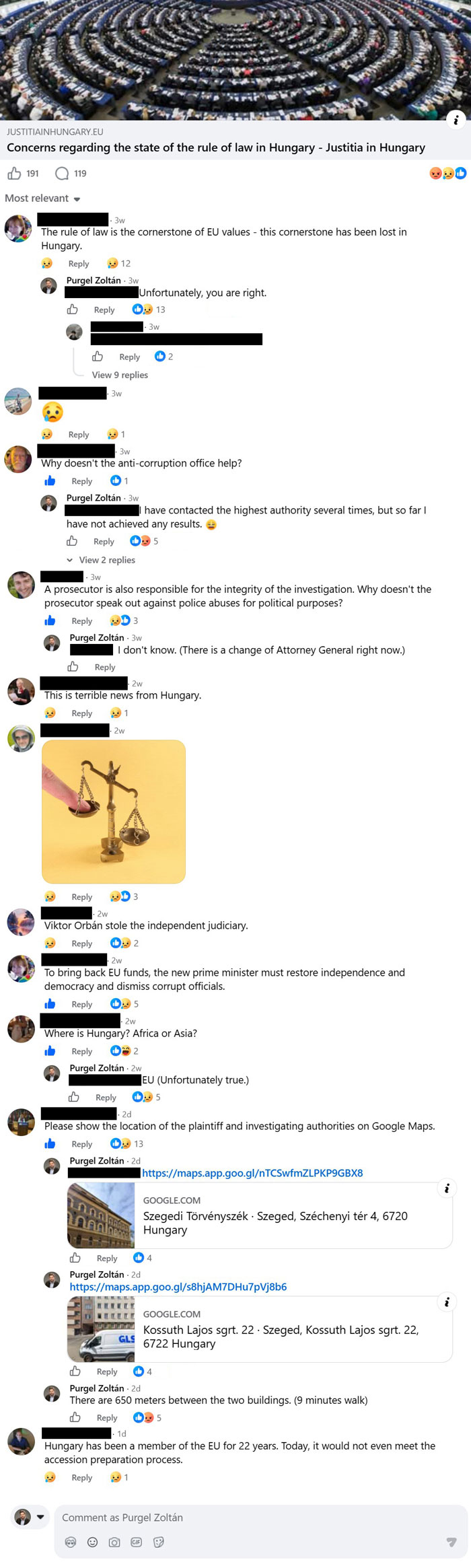
Concerns regarding the state of the rule of law in Hungary
Donate
We are not funded by the government, but by people who agree with our goals.
We use the donations we receive for legal aid, the costs of conceptual procedures and the fines imposed.
If you would like to contribute to these expenses, you can support us with a single monetary donation. Your donation will not only help us finance our expenses, but also confirm that others believe that our work is needed.
Donate with online credit card payment
You can donate us with a one-time online credit card payment, via PayPal’s secure interface.
Donate with online credit card payment

Donate by international transfer
- IBAN number: HU70126000161522430615139310
- Swift / BIC: TRWIBEBBXXX
- Transfer recipient: Zoltán Purgel
- Notice: Justitia support
- Bank address: Wise, Rue du Trône 100, 3rd floor, Brussels, 1050, Belgium
Downloads
Here you can download police reports, court rulings, and prosecution documents related to cases of abuse of power.
Reporting corruption, embezzlement, abuse, bias
Contact
- E-mail: info@justitiainhungary.eu
- Phone / Fax / Voicemail: +36 63 364400
- Editor: Zoltán Purgel
- Person responsible for the publication: Dr. Erik Varga
- Postal address: 6635 Szegvár, Kórógy u. 69. Hungary
- Website: https://justitiainhungary.eu
- Facebook Page: https://www.facebook.com/justitiainhungary.eu